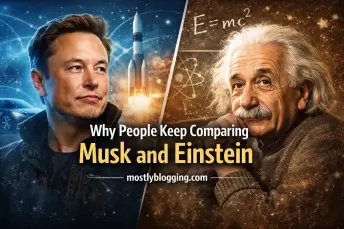
Few debates on the internet spark as much curiosity as “elon musk IQ vs Einstein.” It’s the kind of comparison that feels almost cinematic: a modern tech titan versus the archetype of scientific genius. One builds rockets and electric cars. The other redefined space and time.
But the real question isn’t just who had the higher IQ. It’s deeper than that. What does intelligence actually look like across different eras? And is raw IQ even the right lens to compare them?
Let’s unpack it carefully and realistically.
What Was Einstein’s IQ?
Albert Einstein
There’s no official IQ score recorded for Einstein. Modern IQ testing wasn’t widely standardised during his lifetime, and he never publicly sat for one. However, researchers and historians estimate his IQ to have been somewhere between 160 and 190.
Einstein’s intellectual contributions were staggering:
- Theory of Relativity
- Explanation of the Photoelectric Effect (Nobel Prize in Physics)
- Foundational work influencing quantum mechanics
- Mathematical insights that reshaped cosmology
His mind operated in extreme abstraction. He could imagine riding alongside a beam of light and then derive equations from that thought experiment. That level of conceptual visualisation is rare even among gifted individuals.
Einstein’s genius was theoretical, mathematical, and revolutionary. He didn’t just solve problems; he altered the framework through which reality was understood.
What Is Elon Musk’s IQ?
Elon Musk
Unlike Einstein, Elon Musk’s IQ has never been officially confirmed. Most estimates place it around 155 to 160, though these figures are speculative.
Yet IQ alone doesn’t explain Musk’s impact. He has led or founded companies such as:
- Tesla
- SpaceX
- Neuralink
- xAI
- The Boring Company
His intelligence appears highly applied and systems-oriented. Musk is known for first-principles thinking — breaking complex problems down to their fundamental truths and rebuilding solutions from scratch.
While Einstein worked largely in academic physics, Musk operates at the intersection of engineering, economics, artificial intelligence, aerospace, and large-scale manufacturing. That breadth is itself a marker of unusual cognitive flexibility.
IQ Isn’t the Whole Story
Here’s where the comparison becomes nuanced.
IQ tests primarily measure:
- Logical reasoning
- Pattern recognition
- Working memory
- Mathematical aptitude
They don’t measure:
- Risk tolerance
- Leadership under uncertainty
- Entrepreneurial resilience
- Execution under extreme pressure
Einstein excelled in abstract reasoning at the highest level. Musk demonstrates an ability to apply complex reasoning in chaotic, real-world environments involving billions of dollars and thousands of employees.
Once, while reading about both figures late at night, I realized something striking: we’re often trying to compare a theoretical mind with an industrial mind, as if they operate on the same playing field.
They don’t.
A Clear Side-by-Side Perspective
Instead of debating endlessly, let’s look at their intellectual profiles in context:
| Factor | Albert Einstein | Elon Musk |
|---|---|---|
| Estimated IQ | 160–190 (estimated) | ~155–160 (unconfirmed) |
| Field of Mastery | Theoretical Physics | Engineering & Entrepreneurship |
| Primary Impact | Changed scientific understanding of reality | Transformed multiple industries |
| Style of Thinking | Abstract, mathematical, conceptual | Applied, systemic, multidisciplinary |
| Era | Early 20th century | 21st century technological age |
Notice something important: their strengths sit in different dimensions.
Einstein pushed the boundaries of physics. Musk pushes the boundaries of commercialization and scalability.
Intellectual Performance in Complex Operational Settings
Imagine two scenarios.
In one, a physicist is alone in a quiet room, chalk in hand, scribbling equations that redefine how gravity works. The work may take years to validate, but once proven, it changes textbooks forever.
In another, a CEO faces production delays, investor pressure, engineering failures, and public scrutiny all while attempting to land a reusable rocket on a floating platform in the ocean.
Both require extraordinary intelligence. But the type of pressure, environment, and output differ dramatically.
Einstein’s intelligence reshaped the laws of nature.
Musk’s intelligence reshapes human systems built on those laws.
Depth vs Breadth
Einstein’s brilliance was incredibly deep. He explored spacetime curvature, mass-energy equivalence, and the behavior of light with unmatched mathematical elegance.
Musk’s brilliance appears broader. He reads extensively across physics, software, materials science, artificial intelligence, and economics. He then integrates those disciplines into functioning companies.
Think of it this way:
- Einstein advanced fundamental science.
- Musk industrializes advanced science.
One extends knowledge.
The other accelerates its application.
The Era Effect
Context matters.
Einstein worked in a time when scientific discovery was less commercialized. Research unfolded in universities and theoretical institutes. The 20th century prioritized scientific understanding.
Musk operates in an era defined by rapid iteration, venture capital, global markets, and digital communication. Innovation now requires both technical depth and financial orchestration.
If Einstein were alive today, perhaps he would lead a research institute powered by supercomputers.
If Musk had lived in Einstein’s era, perhaps he would have built industrial laboratories alongside physicists.
Comparisons across centuries inevitably blur the lines.
Public Perception vs Measured Intelligenc
Einstein became a global symbol of genius. His hair, his quotes, his image all iconic. Intelligence became part of his cultural identity.
Musk, by contrast, is often viewed through the lens of controversy, corporate decisions, and social media presence. Yet beneath the headlines is a mind capable of integrating physics equations with supply chain optimization.
Public perception doesn’t always align with cognitive reality.
So Who Had the Higher IQ?
If we’re strictly talking about theoretical IQ estimates, Einstein may edge slightly higher based on historical projections.
But here’s the deeper takeaway:
Raw IQ doesn’t necessarily determine impact.
Einstein proved that time and space are intertwined.
Musk made reusable rockets economically viable a concept once considered impractical.
One unlocked universal laws.
The other challenges planetary limitations.
Intelligence as Impact
There’s a powerful way to look at this comparison:
Einstein’s intelligence expanded what humanity understands.
Musk’s intelligence expands what humanity attempts.
Different expressions.
Different arenas.
Different definitions of genius.
The debate isn’t really about numbers. It’s about what we value more: deep theoretical insight or bold applied execution.
Related: Joyland AI: The Creative Playground for AI Characters and Storytelling
Conclusion
The discussion around “elon musk IQ vs Einstein” fascinates people because it touches something universal our obsession with measuring genius.
Einstein likely possessed a slightly higher theoretical IQ, at least by historical estimation. But Musk demonstrates a rare form of multidisciplinary, applied intelligence that operates at immense scale.
Comparing them directly oversimplifies the nature of intelligence itself.
Einstein changed physics.
Musk challenges industries.
Both altered the trajectory of human progress just in profoundly different ways.
And maybe that’s the most intelligent perspective of all.
FAQs
Did Einstein really have an IQ of 160 or higher?
There’s no official recorded IQ score for Einstein. Estimates range from 160 to 190 based on his intellectual achievements and historical analysis.
What is Elon Musk’s confirmed IQ?
There is no verified public IQ test result for Elon Musk. Common estimates place him around 155–160, but these figures are speculative.
Is IQ the best measure of intelligence?
IQ measures certain cognitive abilities like reasoning and pattern recognition, but it does not account for creativity, leadership, resilience, or execution under pressure.
Who had more real-world impact?
Einstein transformed theoretical physics and modern science. Musk has transformed multiple industries including electric vehicles and private space exploration. Impact depends on how you define it.
Can IQ predict success like Musk’s?
Not necessarily. While high IQ can help with complex reasoning, factors like persistence, risk tolerance, and strategic thinking also play critical roles in large-scale success.